Brooklyn Bridge: 8 Engineering Details Most Visitors Miss
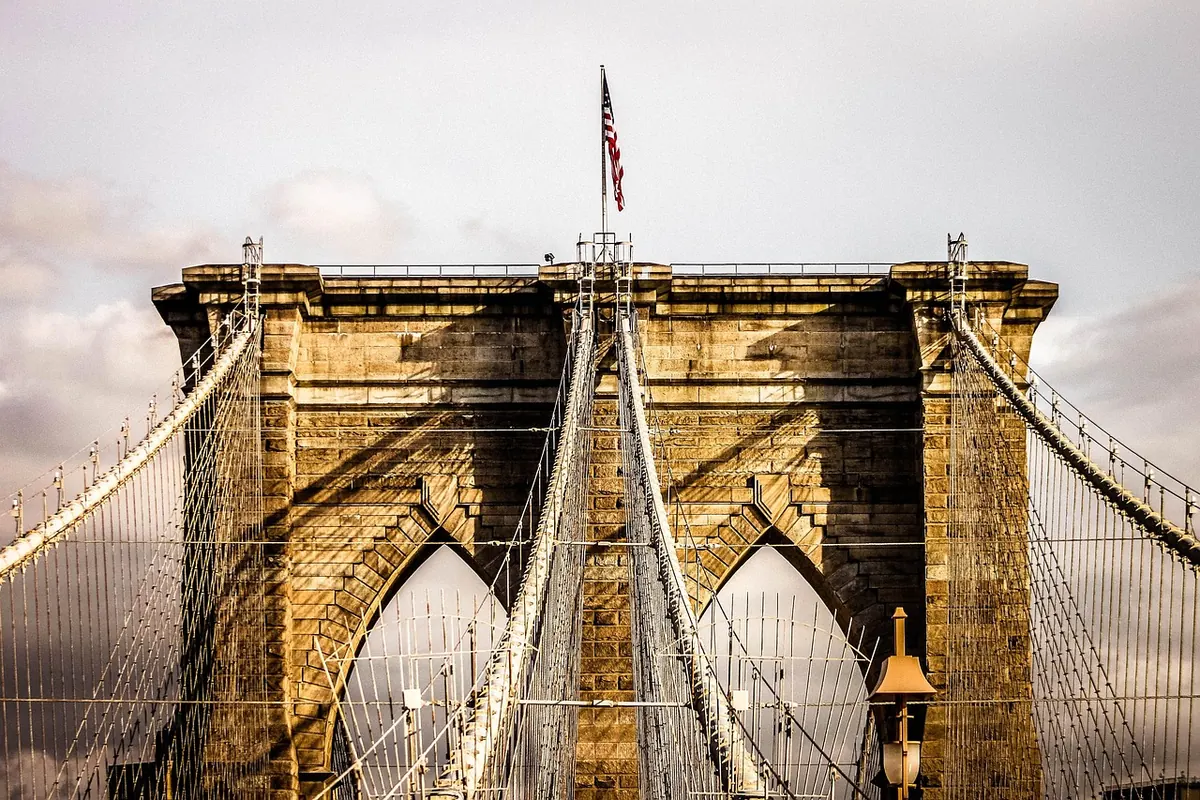
Most people cross the Brooklyn Bridge in about twenty minutes, heads down, following the painted line. That is a fine way to get from Borough Hall to City Hall Park, and a poor way to look at one of the most carefully reasoned structures of the nineteenth century. The elevated promenade puts you inside the machine: the deck is under your feet, the suspenders hang at eye level, and the main cables swing down between the towers like the ribs of something enormous. None of what follows needs a guide, a ticket or a special permit — only a slower pace and a reason to look up.
1. You are walking on a bridge built inside a bridge
The promenade is not the roadway. It is a separate raised ribbon down the centre of the deck, carried on the same steelwork but lifted above the traffic lanes on either side. Stand at the rail and look down: you can see the roadway below, the outer edges of the deck, and — this is the part most people miss — the two outer main cables running below the level of your handrail. From up here you are looking down on the cables rather than up at them, which is why the suspenders read as a curtain of thin vertical lines instead of a distant detail.
Pay attention to the grade, too. From the anchorage the walkway climbs steadily toward the tower, and in cold weather you feel it in your calves. Look back at the tower from halfway up that slope and the arch springs well above the deck — a reminder of how much structure sits between you and the water.
2. Two cable systems are doing two different jobs
This is the detail that repays the most attention, because it explains why the bridge looks busier than a modern suspension span. John Roebling did not rely on a single system. He combined two.
The vertical suspenders
These are the thin, closely spaced rods hanging straight down from the main cables, each one carrying a small slice of the deck up to the cable. They are what you expect to see, and they do the ordinary work of holding the roadway.
The diagonal stays
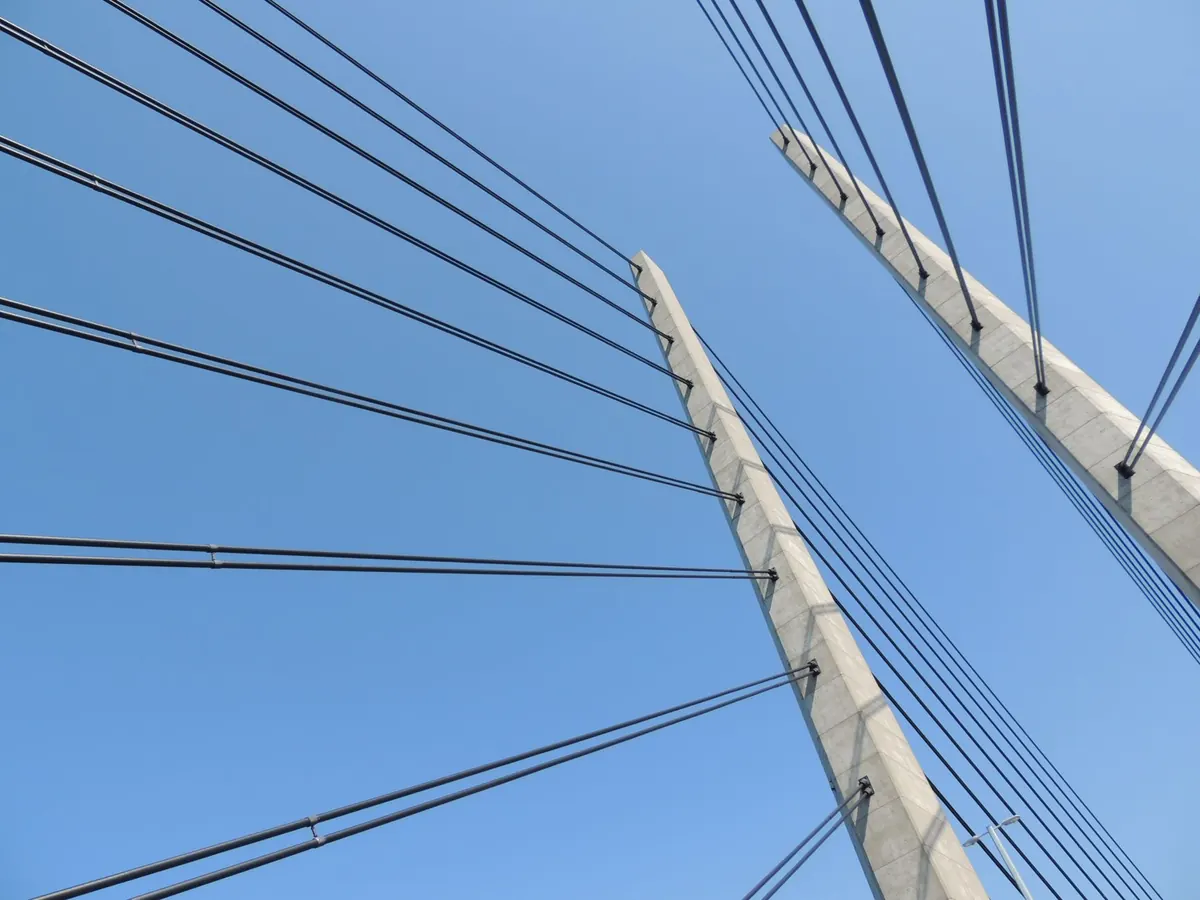
These run in long straight lines from the tower tops down to the deck, fanning out as they descend. They bypass the main cables entirely and tie the deck directly back to the towers. Their job is stiffness: they limit how much the deck can sway, twist and oscillate under wind and moving loads, which mattered enormously for a span of this length in the 1870s.
Look for where the diagonals meet the deck near the towers and you will find forged sockets and threaded rod ends rather than a smooth continuous line. Watch the pattern, too: in the side spans the stays are packed more densely, and they cross the vertical suspenders at shallow angles, giving the walkway its unmistakable overlapping-fan look.
3. The towers are not straight, and the arches are not round
Stand at the base of the Brooklyn tower and look up along one face. The masonry leans inward as it rises — a deliberate batter that widens the base, steadies the tower and lets the eye follow the load down to the pier. You can trace the taper in the stonework itself, because the courses step in rather than curving smoothly.
The two arches in each tower are pointed, not semicircular. That is not only a Gothic gesture. A pointed arch meets its crown at a steeper angle, which pushes the thrust down into the piers more directly than a rounded arch of the same span would. As you walk through, look up at the underside of the vault: the blocks are dressed smooth, the joints are thin, and the whole surface is far more regular than the outside of the tower, where blocks vary in size and an occasional darker stone breaks the pattern.
Also worth a glance: the flat vertical strips — pilasters — running up the faces between the arches, and the heavy projecting cornice near the top. They read as decoration, but they also thicken the masonry where it matters and stiffen a very tall, very slender block of granite.
4. The main cable is not a rope, and it is not quite round
Each main cable is a bundle of thousands of parallel galvanised steel wires, squeezed together and wrapped with a spiral of softer wire. The wrapping is what gives the cable its surface, and it is also why the cable reads as slightly faceted rather than perfectly circular — the wrapping compresses the bundle and pulls the outer wires into a near-polygon.
Now find a cable band: a collar clamped around the cable at regular intervals, with bolts on the side and a suspender hanging from it. The bands grip the bundle, keep it consolidated, and give the suspenders something solid to attach to. Two things to check:
- Band spacing. Compare the gaps near a tower with the gaps near midspan. The rhythm changes because the load does.
- Suspender length. The rods get shorter toward midspan, where the cable dips closest to the deck. Reading that change tells you the shape of the curve without any numbers.
5. The anchorages are the quiet heroes
At each end of the bridge the cables run into a mountain of granite. There is no clever mechanism inside: the cables splay out over curved castings and are embedded in enormous masonry blocks, and the sheer weight and friction of that mass resists the pull. It is the least visible and most essential part of the design.
From the walkway, watch how the cables descend and spread as they approach the ends. By the time they reach the masonry, the tight bundle you saw at the tower has separated into strands. Much of the anchorage is below street level, so what you see above ground is only the top of the box.
6. Below the waterline, the bridge is older than it looks
The towers do not sit on the riverbed as you see it. They rest on pneumatic caissons — vast timber-and-iron chambers sunk under pressure, filled with concrete once they reached their final depth. The Brooklyn tower reached bedrock; the Manhattan caisson stopped in compacted sand and gravel, a decision argued over at the time and ever since. Washington Roebling, who took over the project from his father, was himself disabled by caisson disease from repeated descents.
You cannot see any of that. What you can see is the stone pier at the waterline and the timber fendering around it, there to absorb the impact of barges and ice. From the promenade, lean over the side near a tower and look straight down: the base widens into a plinth, and the transition from dressed granite tower to weathered pier stone is a neat little lesson in how a building meets a river.
7. The small hardware rewards a pause
Walk the length of the promenade once without stopping, then walk it again slowly and look only at joints. Where the deck meets each tower there are bearings and joints that take up the movement of steel and timber as the temperature swings. Along the deck edges you will find scuppers and drainage details — dull, but the reason the walkway survives winters. Under the handrail, the rivets of the truss are visible if you crouch slightly. And the string of lights following the cables, which now looks as if it has always been there, was added for the bridge's centennial in 1983.
How to walk it with your eyes open
You do not need much time, but you do need a plan.
- Start on the Brooklyn side and give yourself the climb first. The approach slope is where the structure starts to make sense.
- Stop at the first tower and spend five minutes on the tower itself before looking at anything else: the batter, the pointed arches, the coursing.
- Walk the main span slowly and watch the suspenders shorten and the diagonals splay out. Look down over the rail once, then look back up.
- Pause at midspan and turn around. Both towers in one view is the clearest way to see how the cables curve and how much deck hangs between them.
- Finish at the Manhattan anchorage and watch the cables fan out into the masonry.
Go early in the morning if you want the rails to yourself, and bring a light jacket — the wind on the main span is stronger and colder than it feels at either end. Binoculars are optional but useful for the tower tops; a pair of knees that can handle the slope is not.
Photo: BeLichtErstatter / Pixabay