A Local's Guide to Rome's Historic Bridges: 7 Crossings Worth a Detour
Rome has a lot of bridges and no shortage of opinions about them. Ask someone from Prati and they will defend Ponte Sant'Angelo; ask someone from Trastevere and they will shrug at it and point you towards Ponte Sisto instead. The Tiber loops through the historic centre in a long S, and the crossings along it were built for wildly different reasons: a Roman consular road, a pope's Jubilee shortcut, a barricade in a siege, a drain for a growing city.
Walking them is one of the few ways to read the city's layers without queueing for anything. What follows is a route-minded guide: which crossings deserve the detour, where to stand once you get there, and how to reach each one on foot or by public transport.
Ponte Milvio: The Northern Anchor
Start where the city thins out. Ponte Milvio carries the old Via Flaminia over the river and has been repaired so often that almost nothing of the ancient structure is visible — what you see is largely nineteenth-century work, rebuilt after the 1849 siege of the Roman Republic. The name comes from the battle fought here in AD 312, when Constantine defeated Maxentius just upstream; the story of the vision before the fight has been attached to this stretch of the Tiber ever since.
It is now effectively closed to ordinary traffic, which makes it the most relaxed crossing in Rome. The padlocks that once weighed down the lampposts have been swept away more than once, so don't be surprised if the ritual has simply moved a few metres along the railings.
Getting there: tram 2 from Piazza Flaminio to Piazza Mancini, then walk five minutes. Best view: the downstream side, an hour before sunset, with the tower in profile and the river low in summer. The Auditorium and MAXXI are both a short walk back towards Flaminio if you want to extend the afternoon.
Ponte Sant'Angelo: The Processional Crossing
Hadrian's bridge, finished around AD 134, was built to reach his mausoleum — the cylindrical mass that became Castel Sant'Angelo. The ten angels carrying the instruments of the Passion were designed by Bernini and carved largely by his workshop in the late 1660s, and they are the reason the bridge is now a slow-moving file of people with phones held at chest height.
Come early. Between roughly ten and four the bridge belongs to guided groups, and the pavement is narrow enough that a single tour cluster stops everyone. At seven in the morning you can have the angels to yourself and hear the water.
Getting there: from the centro storico, take Via del Banco di Santo Spirito from Campo de' Fiori; from the north, follow Via di Ripetta to the lungotevere. Best photograph: not on the bridge itself but from Ponte Vittorio Emanuele II, one crossing downstream, where the whole line of statues sits against the castle.
Ponte Sisto: The One You'll Cross Twice
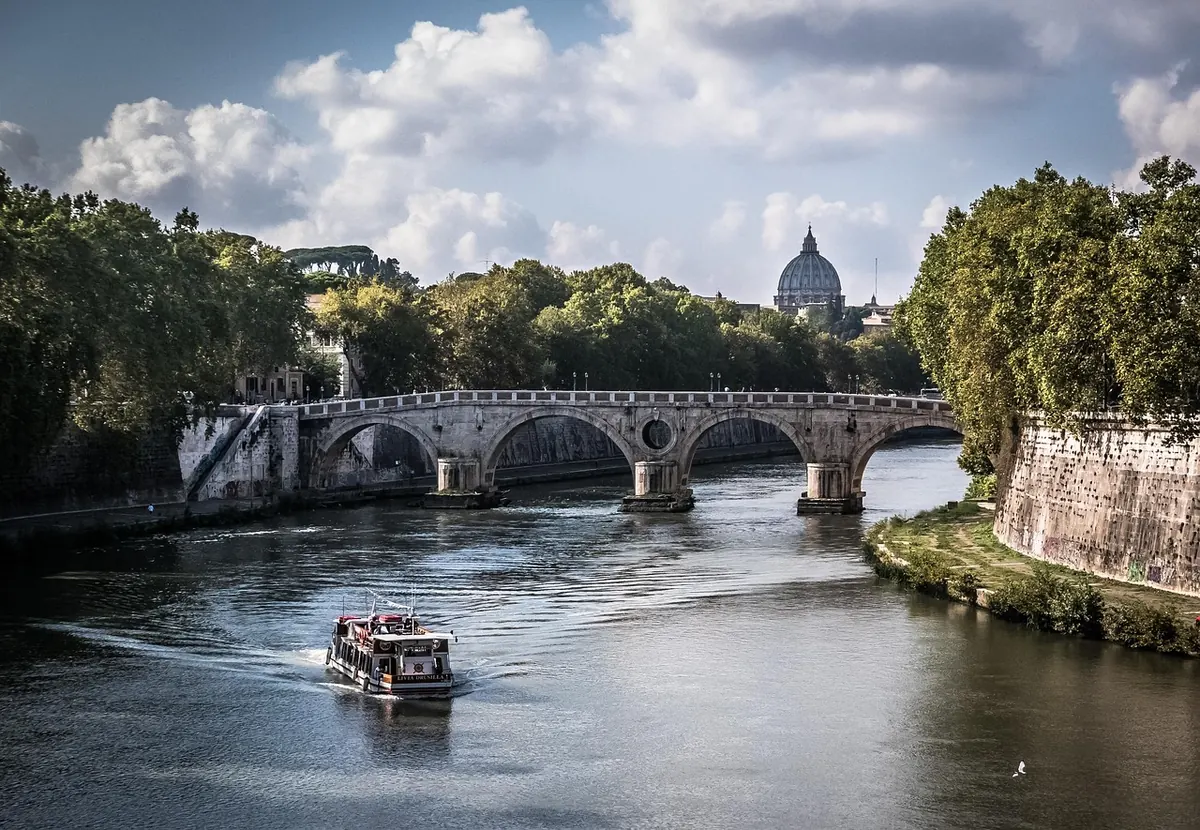
Built for Sixtus IV between 1473 and 1479, Ponte Sisto replaced a Roman predecessor that had collapsed and gave pilgrims heading for St Peter's a way over the river that didn't depend on a ferry. Look at the central pier: there is a large circular opening through it. It is there to lighten the pier and let floodwater pass, and it gives the bridge its instantly recognisable silhouette.
This is the pedestrian bridge of the historic centre, linking the Campo de' Fiori side to Piazza Trilussa in Trastevere. On a warm evening the steps at the Trastevere end fill up, and the whole span becomes a place to stand rather than a way to get somewhere.
Best view: stop halfway and look west — the Tiber Island sits upstream and the Gianicolo rises behind Trastevere. Local habit: cross once in daylight for the view, then again after dark, when the floodlights come on and the crowd thins after eleven.
The Island Pair: Ponte Fabricius and Ponte Cestio
The Tiber Island is the pivot of the whole river, and it is held in place by two very different bridges. Ponte Fabricius, finished in 62 BC, is the oldest bridge in Rome still carrying people across the water; the names of the two men who paid for it are still legible on the stone. Ponte Cestio, on the Trastevere side, was heavily rebuilt in the nineteenth century but kept much of its original material, so the join between old and new is visible if you look along the parapet.
The island itself is worth twenty minutes. San Bartolomeo stands where a temple to Aesculapius once did, a hospital has operated here since the sixteenth century, and at the western tip the travertine prow is carved to suggest the ship that brought the god's snake upriver.
- Access: from Via del Teatro di Marcello, drop down to Lungotevere dei Pierleoni for Ponte Fabricius.
- Don't miss: the ship's prow at the island's western end, best seen from the bank rather than the bridge.
- Time it: weekday mornings are quietest; Sunday afternoons the island gets busy with families.
Ponte Palatino and Ponte Rotto: The Best Free View in Rome
Ponte Palatino is nobody's favourite bridge — a late nineteenth-century span that replaced an earlier iron footbridge and carries a busy road. Go anyway. Stand on the downstream pavement and look over the parapet.
What you're looking at
A single arch of the Pons Aemilius, the stone bridge Romans knew as Ponte Rotto, "the broken bridge". It was built in the second century BC, repaired for centuries, wrecked by floods, and finally stripped back to one arch in the 1880s when the new crossing was built. Just beside it, at the foot of the Palatine near the round temple in Piazza Bocca della Verità, is the stone mouth of the Cloaca Maxima, still draining into the Tiber after more than two thousand years.
Tip: this view faces east, so it is a morning shot. Come at eight with a coffee from a bar on Via dei Cerchi and you will have the arch, the temple and the drain entirely to yourself.
Ponte Nomentano: The Detour Worth the Bus Ride
Every other crossing here spans the Tiber; this one crosses the Aniene, three kilometres or so out along Via Nomentana. It is a medieval fortified bridge with a tower at one end, now pedestrian, set in a small riverside park. The Romans built here, the tower came later, and legend insists Hannibal camped nearby — treat that as a story rather than a fact and enjoy it anyway.
It is the only bridge on this list where you can hear birds instead of traffic. Bring something to eat, sit on the bank, and walk a stretch of the Aniene path before heading back. Getting there: any bus running along Via Nomentana towards the Aniene; ask the driver which stop is closest to the bridge, as the paths down to it are not obvious from the road.
Practical Notes: Timing, Access and a Route
Rome's riverbanks are beautiful and not always convenient. The lungotevere is a fast road, and the crossings are the safest places to get across it — use the marked underpasses near each bridge rather than dashing between cars. Staircases down to the water open and close unpredictably, and some are gated outside the summer season, so never plan a walk that depends on one particular set of steps.
Travertine and sampietrini cobbles turn slick after rain; flat shoes with grip make the walk far more pleasant. The nasoni fountains along the streets give you free drinking water, so carry a bottle instead of buying one.
- Ponte Milvio at sunset, with a drink in the piazza afterwards.
- Ponte Sant'Angelo early the next morning, before the groups arrive.
- Walk south along the left bank to Ponte Fabricius and cross to the island.
- Continue over Ponte Cestio into Trastevere for lunch.
- Come back via Ponte Palatino for the Ponte Rotto view.
- Finish at Ponte Sisto in the evening, when the steps fill up.
- Save Ponte Nomentano for a separate half-day with no fixed schedule.
If you have only one afternoon, do the island pair and Ponte Palatino. Three crossings, one hour of walking, and the clearest picture of what Rome's river has been used for over two thousand years.
Photo: martieda / Pixabay